The facelift has accumulated language faster than it has accumulated clarity. Patients arrive with terms like deep plane already in mind, often drawn from short videos and promotional material. They ask for a category of operation without understanding what that category entails, and they assume that deeper dissection produces better results. They also assume that more extensive surgery produces a more lasting correction, which is not always the case.
A facelift, medically known as a rhytidectomy, is a cosmetic surgical procedure designed to create a more youthful appearance by reducing sagging skin and wrinkles on the lower two-thirds of the face and neck. As a type of cosmetic surgery, a facelift is a surgical procedure that can address deep folds, loose skin, and excess facial fat, but it cannot halt the natural aging process.
The modern facelift has drifted toward scale rather than precision. Surgeons have gone deeper, released more tissue, and lifted larger portions of the face as a single unit. The results can be effective, but the cost appears in swelling, recovery time, and increased risk. Many patients accept that trade without fully understanding the burden that follows.
Dr. Edwin Ishoo begins from a different premise. “People are no longer looking for drastic changes, but rather to restore a younger version of themselves.” That statement establishes a boundary and a goal at the same time. If restoration is the objective, then the operation must become selective rather than maximal.
FlexLift is performed in an office setting under local anesthesia, and that decision shapes the entire procedure. The surgeon cannot rely on broad dissection under general anesthesia, which forces careful selection of where intervention is necessary. The procedure combines a face and neck lift into one operation while limiting the extent of tissue separation throughout the process.
The procedure typically takes under two hours, and patients return home the same day. Recovery occurs over days rather than weeks, which changes how patients experience surgery and how they plan their lives around it. “FlexLift delivers refreshed, natural-looking and long-lasting results comparable to a full-facelift without the downtime, cost, or risks associated with traditional facelift surgery,” Dr. Ishoo explains, framing the comparison in practical terms.
Facial aging does not originate at the surface, even though it becomes visible there. Skin reflects the changes that occur beneath it, where structure determines position and contour. The superficial muscular aponeurotic system, known as the SMAS, provides the primary support for facial soft tissues.
When the SMAS weakens, the visible signs of aging emerge in a predictable sequence. The cheeks descend, the jawline softens, and folds deepen around the mouth. Traditional approaches often addressed the skin or performed broad lifting beneath the SMAS, which did not always respect the structural complexity of the face. “The goal is not simply tightening the skin,” Dr. Ishoo states. “FlexLift allows us to restore the underlying support structures and youthful proportions and contour of the face.” Surgical techniques for facelifts involve repositioning underlying tissues and deeper tissues to achieve natural and long-lasting results.
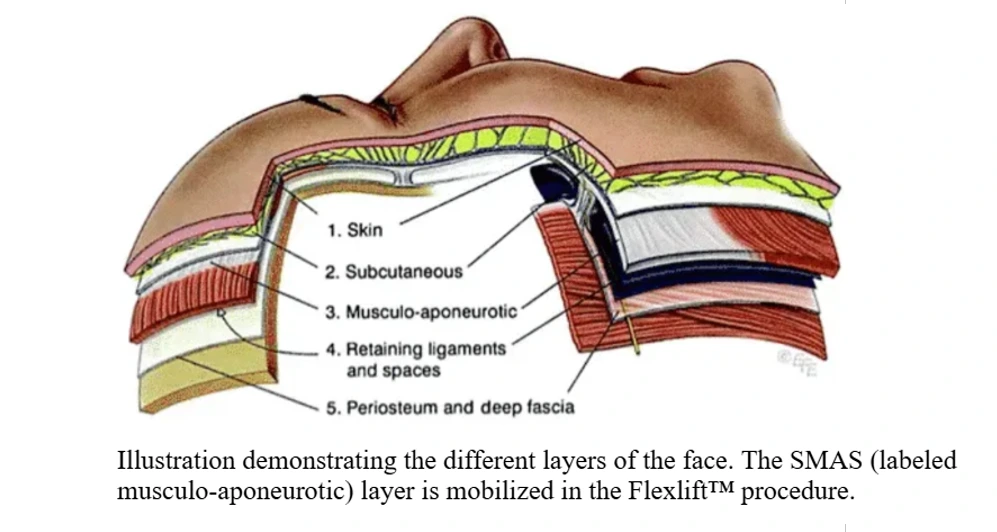
Facial tissues remain in position because retaining ligaments anchor deeper structures to the skin. These ligaments maintain structure in youth and gradually weaken with time. As they loosen, the face descends in a way that appears gradual but is structurally consistent.
FlexLift focuses on the most important of these ligaments rather than releasing all of them. The surgeon identifies key points that influence midface position and jawline definition, then releases and repositions those selectively. The ligaments are elevated and resuspended rather than completely disrupted, which preserves structural continuity.
This selective approach reduces the amount of tissue that must be separated during surgery. Less separation leads to less swelling, less bruising, and a shorter recovery period. The face repositions itself with less force applied, which produces a more natural result over time.
Aging involves loss as well as descent, and the midface often loses volume in a way that changes the entire appearance. The cheeks flatten and the face appears hollow even when the skin remains intact. Lifting alone cannot correct this problem, because the underlying volume has diminished.
FlexLift incorporates fat grafting to restore that missing component. Small amounts of the patient’s own fat are transferred to areas that have thinned, which reestablishes contour without creating excess. “Fat grafting may restore midface volume and restore a youthful contour and balance,” Dr. Ishoo notes, emphasizing balance rather than augmentation.
In other patients, excess facial fat beneath the chin or along the jawline reduces definition. The procedure allows for selective fat removal in those areas, which sharpens contour and improves proportion. “The procedure is flexible and adapts to the patient’s anatomy and recovery timeline,” he explains, reinforcing the individualized nature of the operation.
FlexLift operates across multiple layers, but it does not treat all layers equally in every patient. The surgeon may adjust the skin at the surface, reposition the SMAS where needed, and address deeper structures selectively. The approach varies based on anatomy and the extent of aging.
This stands in contrast to the widespread use of deep plane techniques, which involve lifting large portions of the face beneath the SMAS. Deep plane facelift surgery involves repositioning deeper facial tissues and muscles, allowing for a more thorough lift without tightly pulling the skin, which can result in a more natural appearance and longer-lasting results. The standard facelift, also known as the SMAS technique, addresses moderate to advanced aging around the mid-face and neck, requiring more extensive surgery and recovery time than a mini-facelift. A mini-facelift is a less invasive procedure that targets mild jowling and sagging skin, using shorter incisions typically located along the hairline above each ear. The deep plane facelift, by contrast, repositions deeper tissues for more natural and durable outcomes.
Deep plane surgery can be effective, but it requires general anesthesia and extensive dissection. Recovery often lasts longer than patients expect, particularly when swelling persists.
FlexLift modifies that concept by limiting the extent of intervention. It achieves structural correction without committing the patient to a prolonged recovery process, which changes the balance between result and burden. During a facelift, extra skin is removed to improve facial contours, reduce sagging, and address deep folds and loose skin that develop as part of the aging process.